
Hello friends,
Hope you’re doing well.
There is a huge buzz out there to adapt Artificial Intelligence in a growing number of use cases. While craze is understood especially with the kind of efficiency and productivity gain AI brings, however one needs to be mindful of the challenges as well that come along.
In short, Responsible AI is a key for a sustainable future.
Major Benefits of AI:
- Efficiency: Efficiency and productivity are one of the key benefits of AI, it makes work more efficient and easier, and can automate repetitive tasks. Some of the use cases include automation of repetitive tasks such as chatbots, robotic process automation, workflow optimization, AI-driven scheduling systems etc.
- Data-driven insights: AI with well-trained data models, present data-driven insights and can help make logical decisions. Some of the prominent use case can be predictive analytics in finance, marketing, or healthcare, consumer behaviour analysis in recommendation systems and risk assessment.
- Accessibility: This is one of the advantage benefits people with disabilities. Few prominent uses can be said as voice recognition for hands-free controls, text-to-speech and speech-to-text for people with visual or hearing impairments and AI-powered adaptive technologies.
- Safety: AI can improve workplace safety, for example by stopping machinery when workers get too close to restricted areas. AI can also help drivers stay alert by warning them when they drift out of their lane. Some of the use cases are autonomous vehicle safety during vehicle collision avoidanc, detecting anomalies etc.
- 24/7 uptime: This is yet another advantage of AI that it can run 24/7 without breaks, and it can do the same task consistently. You can think of few use cases such as monitoring server health and responding to technical issues in cloud infrastructure management, predictive maintenance in critical infrastructure.
Distribution of AI benefits:
The distribution of AI benefits across different categories can vary depending on the industry, however, we have presented a rough percentage of how AI can be used across key areas, based on general trends.
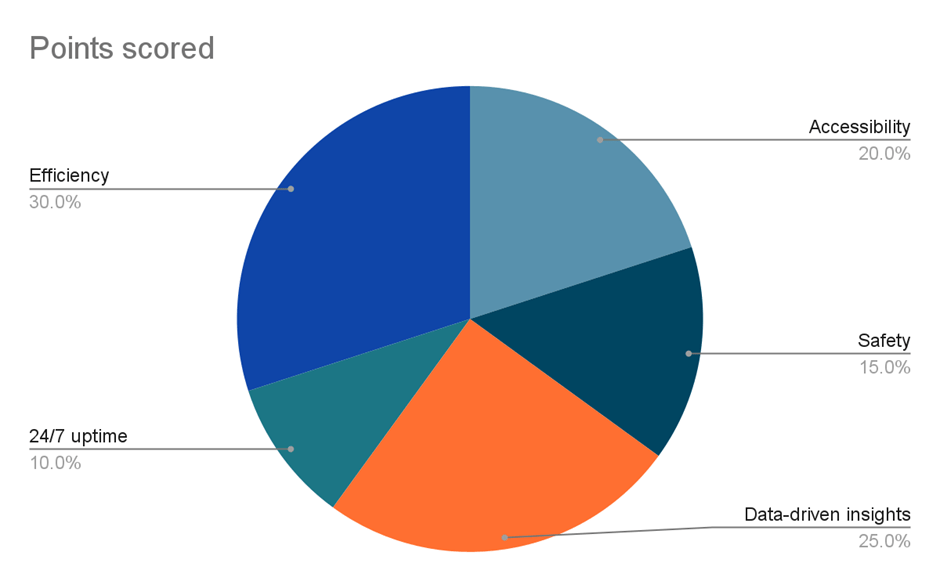
Please note that these percentages can very based on specific industries. For example, a tech startup might focus more on Efficiency and Data-Driven Insights, while a healthcare application might prioritize Accessibility and Safety.
Now let’s go over the some of the cons where it brings some challenges to society in general.
Challenges of AI:
- Job loss: This is one of the major threats being perceived in the society. AI has potential to replace human jobs, which can lead to mass unemployment. For example, automation in manufacturing can lead to robots replacing factory workers, another example could be chatbots replacing call centre agents.
- Privacy risks: AI can pose privacy risks. For example, cybercriminals can compromise an AI system to steal customer data. AI-powered surveillance systems can track individuals without consent, leading to potential breaches of privacy.
- Ethical concerns: AI may use questionable data collection practices and can lead to biased responses. Few examples to consider such as bias in AI algorithms such as biased hiring practices, lack of accountability when AI makes erroneous decisions for ex, in autonomous vehicles.
- Environmental concerns: AI data centres consume more power and water than regular data centres due to large data churning. Some of the main concern are carbon footprint of training large AI models, especially in deep learning which requires vast amounts of energy.
- Threat to human creativity: Excessive use of AI can discourage humans from using their own intelligence and emotion and over time their creativity may be compromised. For example, AI-generated art and music can challenge traditional ideas, AI could be used to lower the value of human-created creative work.
Distribution of AI threats:
The potential adverse impacts of AI can be distributed across various concerns in a similar way to the benefits, though the specific percentages can vary depending on the context and sector. Here’s a general breakdown of the main AI cons and their estimated distribution.
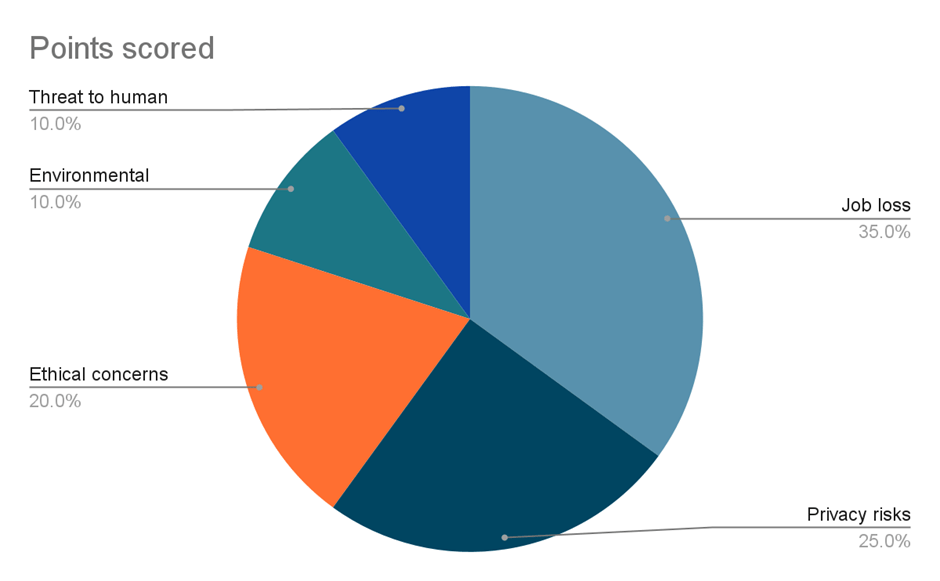
This distribution provides a general overview, with Job Loss being the most commonly discussed concern due to the widespread impact automation. Privacy Risks and Ethical Concerns come next because of their implications for individuals and society. Environmental Concerns and the Threat to Human Creativity are important however often seen as secondary compared to the more immediate consequences of job displacement and ethical issues.
Summary:
To summarise, the most benefit of AI is the ability to enhance productivity, provide valuable insights, improve accessibility, ensure safety, and maintain uptime. These benefits lead to economic growth, enhanced user experiences, and better decision-making across various sectors and industries.
On the other side, the challenges are the risks of job displacement, privacy violations, ethical challenges, environmental impact, and the potential to undermine human creativity. These issues raise concerns about fairness, sustainability, and the future of work, requiring careful consideration and regulation. While AI offers substantial advantages, its challenges must be addressed to ensure that its benefits are maximized over negative effects on society.
Hope you liked the article, looking forward for your comments and suggestions in the section below.
 Techy Prakash
Leave a comment